
History of The Park at Governor Dick and its immediate neighbors.
06/15/2026 The following is an old version of the history, written on or around 2002, and since much new information has come to light, it should be read with a critical eye. New text is in the works, thanks to the current exhaustive research that Kathy Lindert is doing on the enslaved man who sparked the name for which the park is named.
Iron and Steel
The woodlands on the Furnace Hills (the name of the series of ridges upon which Governor Dick sits, forming the southernmost hiccups locally of the Appalachian range) are not first-growth forest; having all been cut and regrown a number of times, certainly back in the heyday of the nearby iron furnaces and foundries. The very name Furnace Hills is a big clue.
Originally the cut wood was burnt in the forges, but as technology progressed, charcoal derived from wood was determined a far more effective fuel for furnaces. The charcoal was actually made up in the forests: A large circle of trees were felled, trimmed, cut up into manageable sizes and heaped in the center of the new clearing. Covered with an insulating layer of dirt then fired, the wood smoldered for a long period, weeks, until the wood had all been reduced to charcoal. This lighter and far easier to transport fuel was then transported down the mountain and off to the nearby furnaces (such as the excellently preserved and visitable Cornwall Iron Furnace nearby). A practiced eye can still make out signs of such charcoal circles in the forests to this day.
Early Settler Owners and Uses
An early owner of the local forests was an English emigrant called Peter Grubb, who recognized and exploited the confluence of excellent iron-ore bearing rock in the mountains, free-flowing streams and a ready source of combustible fuel to hand. Grubb sold out to the first Robert Coleman in the late 1700s. The Coleman family profited most from the woodlands and the area as a whole; their marks are everywhere.
Governor Dick: The Man and the Mountain
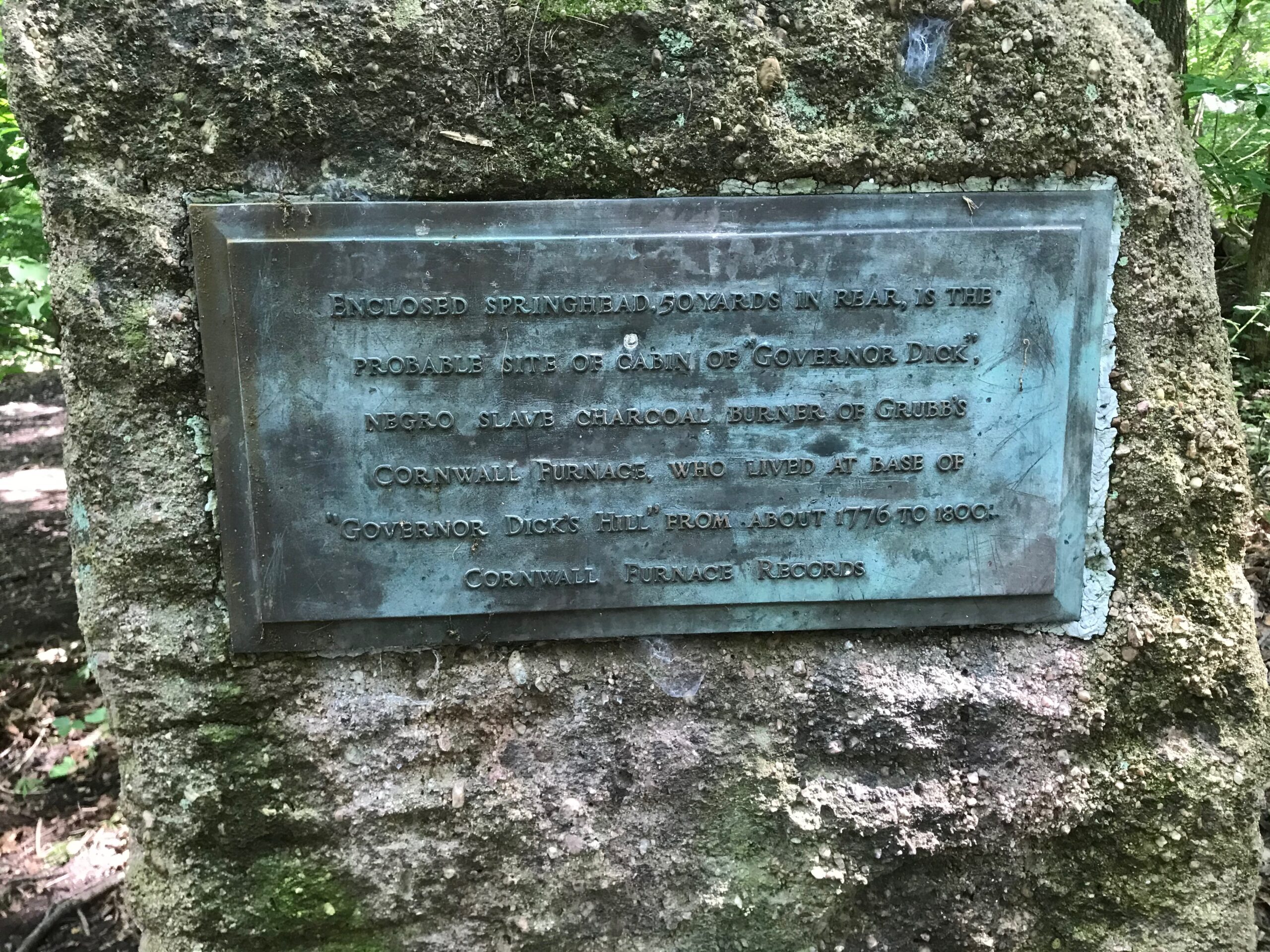
Thanks to recent research done by area resident, Kathy Lindert, we now know much more about the man called Governor Dick.
What We Know:
- Governor Dick was a real person – an enslaved man at Cornwall Iron Furnace (1772-1796)
- His story was part of a larger enslaved community at Cornwall that included men, women, and children whose lives can be traced through archival records
- Governor Dick was an elder and recognized leader in the community, and not a charcoal burner as later tradition suggested
- He escaped in 1796, amid rising instability at Cornwall
- The hill was named “Governor Dick’s Hill” during his lifetime, while he was enslaved at Cornwall – and that legacy has endured
- The archives contain rich information on the overall system of work and daily life at Cornwall – for the enslaved community and for paid workers
What We Don’t Know:
- Exactly what his “Governor” title meant in daily practice
- The qualities of his character that set him apart to bestow trust, respect, and leadership – since these qualities lie outside the accounting system found in the archives
- Why this specific hill was named for him
This research is on-going and may yield further answers to these remaining mysteries.
Contact: Kathy Lindert, KathyLindertArt@gmail.com for more information on Governor Dick and the enslaved community of Cornwall Iron Furnace
Mount Gretna
 Robert Coleman, a late-nineteenth century industrialist, built a park for the enjoyment of his employees and their families along one of his railway lines, built to transfer ore in and iron and steel out of his Cornwall-based empire, at what was a watering stop for the typically thirsty railway engines of the time. Fancifully, it was named Mount Gretna, supposedly after the Scottish border town of Gretna.
The park steadily grew; refreshment stands, an exhibition hall (now the roller rink), a lake from the dammed Conewago Creek, a rather posh hotel built at the west end of it; all in all, a splendid resort. He sold some 80 acres on the far side of the valley to the Pennsylvania Chautauqua for them to hold their annual summer meetings; a tract similarly went to the United Brethren Church for their summer Camp Meeting on the opposite side of what is now Pinch Road for them to do likewise. Members of these two organizations built themselves summer cottages in these two developments—in the case of the Camp Meeting, houses on allotments intended and sized accordingly for tents!
The result by the turn of the century was a culturally rich community revolving around marvelous public buildings and a plethora of closely-packed typically Victorian gingerbread adorned munchkin houses, and further enhanced by the new and less physically constrained development of Gretna Heights, to the east of Campmeeting.
Narrow-Gauge Railway

Robert had a fascination with railways; much as some of us have built model railways in spare bedrooms or basements as a hobby, he decided to build a toy train-set writ large, as his considerable means afforded.
As an entertainment for visitors to his park, this narrow-gauge railway (2-ft. gauge) started adjacent to the main Cornwall and Lebanon Railroad station in the park, ran beside Soldiers Field and behind the lake, passed in front of the hotel (where guests may have alighted or embarked) and across what is now Rte. 117. It then climbed up behind the Chautauqua and eventually crossed Pinch Road above Campmeeting. It went up the hill for half-a-mile or so until it reached a switchback, a large loop, on which the train reversed itself in order to best follow the terrain up the hill. Still climbing, clockwise up the steep hillside in a tight loop around the dome of the mountain, where the tower atop Governor Dick now stands.
Clarence Schock
A self-made man in the fuel-oil business, Clarence Schock steadily bought up the tracts that now form the park; from Henry Koser in 1934, Farmers National Bank of Lititz in 1937 and finally Bethlehem Steel in 1940. It was a glorious nature preserve for him and his wife, Evetta. In 1953 he granted it to the Mount Joy School District to administer, with the idea of it being a nature reserve for the children of that district, and a publicly accessible park. Administration and ownership was transferred to Lebanon County, which appoints a governing board.
Last edited: 25 June 26